

Two questions that look like one
“How much did I earn this month?” “How much money came in this month?”
If you answered both with the same number, there is a good chance at least one of the answers is wrong — and that the decision made from it is wrong too.
These questions measure different things. The first is accrual basis. The second is cash basis. Both are legitimate, both are necessary, and confusing them is probably the most expensive financial-management mistake there is in a small or mid-sized company.
What each basis sees
Cash basis records the event when the money moves. Sold today, paid in sixty days? The revenue arrives in sixty days. Bought today, paying in thirty? The expense lands next month.
It is the bank statement’s basis. Simple, concrete, impossible to argue with.
Accrual basis records the event when it happens, regardless of payment. Sold today? The revenue is today’s — the customer already took the goods and you already did your part. Used electricity in March? The expense is March’s, even if the bill falls due in April.
It is the basis that answers whether the operation stands up.
The distinction is not academic. Look what it does to a single sale:
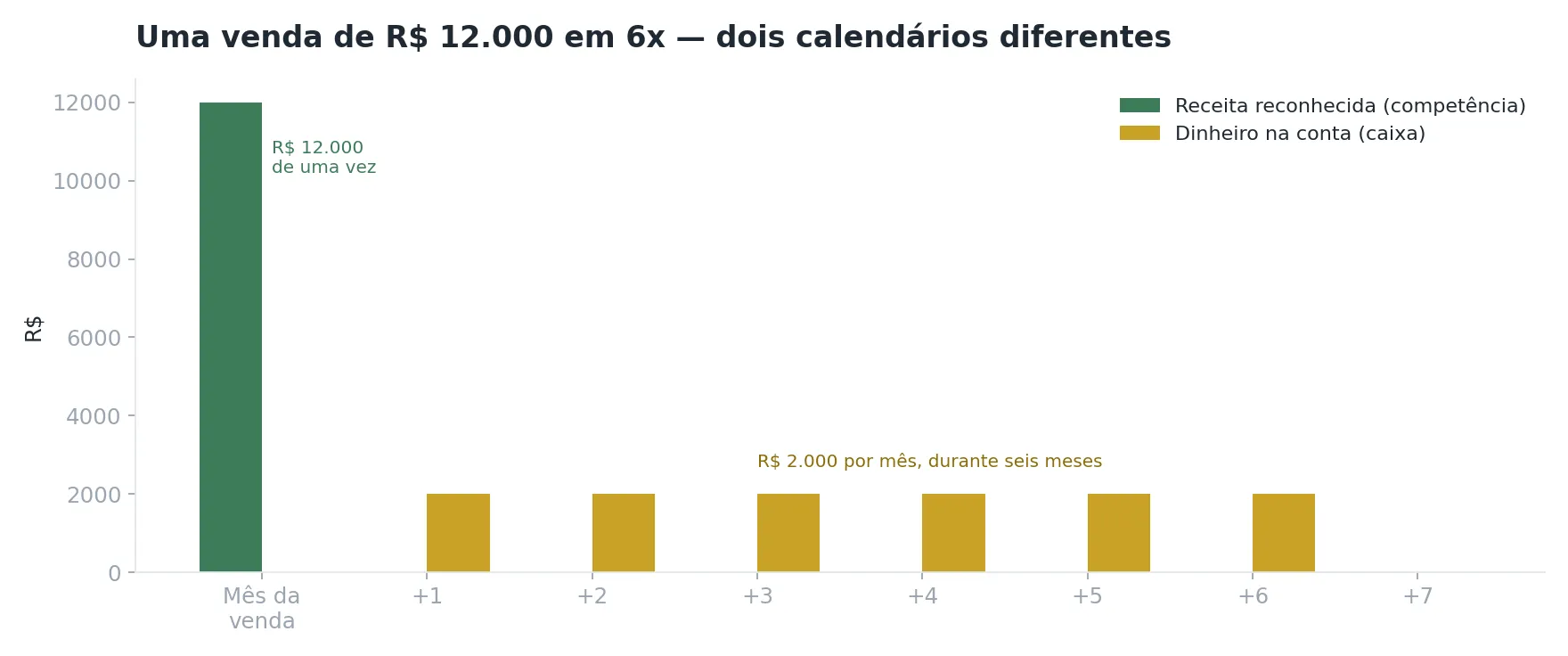
A R$ 12,000 sale in six instalments is R$ 12,000 of revenue in the month of the sale and six R$ 2,000 inflows across the following six months. These are not two events: it is the same event seen through two different rulers.
What you are probably using without knowing
Here is the point that gives this article its title.
Your formal accounting uses the accrual basis. It is mandatory, and your accountant does it correctly.
But the management of most companies runs on a cash basis without anyone having decided so. The owner looks at the bank balance. Finance works from this week’s payables. Monday’s conversation is about what falls due on Thursday. The accountant’s report, on an accrual basis, gets filed unread because it arrives forty days later and speaks a language that does not feel useful.
The result is a company that decides on cash and reports on accrual. Two parallel realities that never meet — and each hides from the other exactly what would be most important to know.
How cash basis deceives: the company that grows and fails
This is the classic case, and it is remarkable how often it repeats.
Picture a shop with a 35% gross margin, growing 8% a month. It sells 70% in six card instalments — perfectly normal in furniture, appliances, clothing, building materials. It pays suppliers in thirty days and needs to restock to keep up with growth.
It is profitable every single month. Every one, without exception.
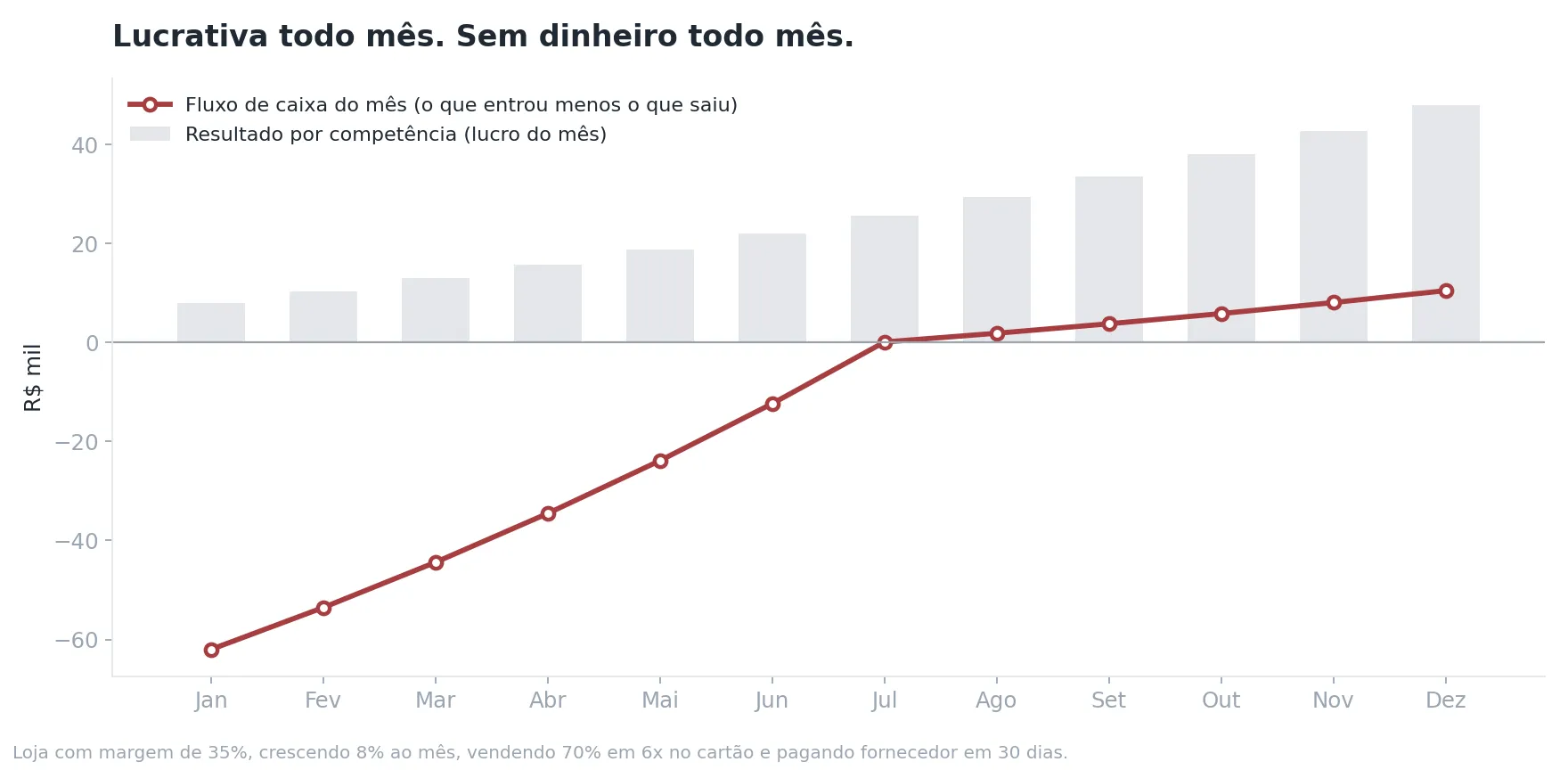
The grey bars are each month’s real profit: it starts at R$ 8k in January and reaches R$ 47.9k in December. The operation works.
The red line is the money. For the first six months cash is negative every month — January alone consumes R$ 62k. Cash only crosses zero in July, and even then only just.
And the cumulative picture is the alarming one:
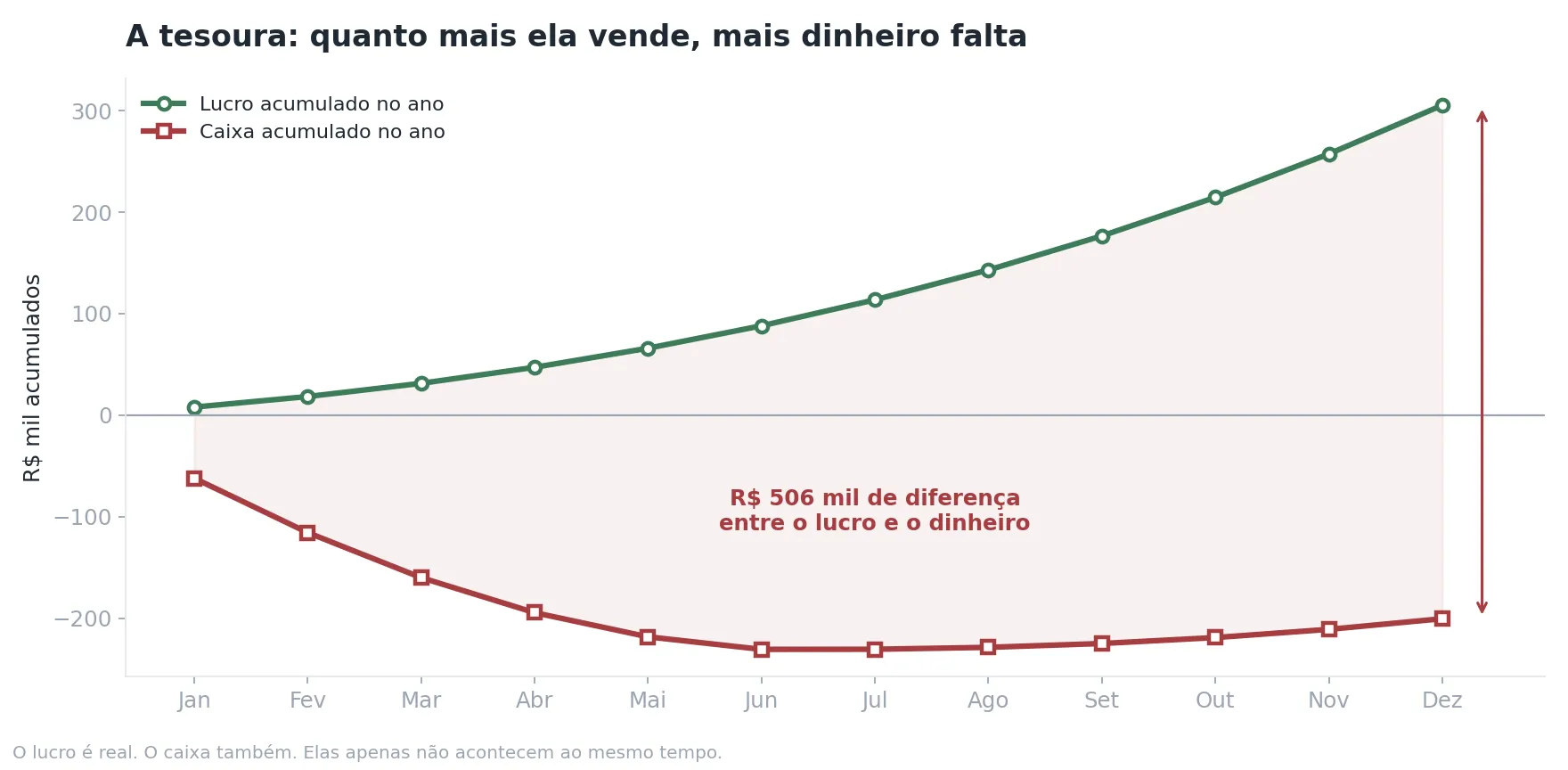
After twelve months, this company has accumulated R$ 305k of profit and a cumulative cash position of minus R$ 200k. A gap of R$ 506k.
Neither number is a lie. The profit is real: the sales happened, the margin exists. The cash hole is real too: somebody had to finance it — working capital, receivables factoring, an overdraft, or the owner’s pocket.
The R$ 506k did not vanish. It sits in receivables and in inventory. It is the company’s money that has not yet reached the company’s account.
Whoever reads only cash concludes the business does not work and puts the brakes on growth — killing a healthy operation. Whoever reads only accrual concludes everything is fine and keeps accelerating — until the day payroll cannot be met. Both are reading half the information.
How accrual basis deceives
It is not a superior basis. It has its own deceptions, and they are worth knowing.
Profit on paper does not pay salaries. A flawless income statement does not stop the company from lacking the R$ 40k for payroll on the 5th. Accrual measures performance, not solvency.
Bad debt takes a long time to surface. The sale became revenue immediately. If the customer never pays, the adjustment only happens when somebody recognises the loss — which usually takes months, sometimes years.
Buying inventory is not an expense. This is the inverse mistake, and it is common. Buying R$ 80k of goods is not R$ 80k of expense: you swapped money for inventory, one asset for another. The expense arises when the goods are sold, and only for what was sold. Companies that book the whole purchase as that month’s expense see phantom losses in every restocking month — and equally false profits in the months that follow.
The practical rule
There is no “correct basis”. There is the question you are asking.
| Your question | The basis that answers it |
|---|---|
| Is the operation profitable? | Accrual |
| Is the price right? | Accrual |
| Should I cut this expense? | Accrual |
| Does this product make money? | Accrual |
| Can I meet payroll on the 5th? | Cash |
| Can I buy upfront for a discount? | Cash |
| Do I need working capital? | Cash |
| When can I take a distribution? | Cash |
Accrual to decide the direction. Cash to decide the next step.
A mature company does not choose between the two — it reads both reports side by side and understands why they differ. When the gap between profit and cash widens consistently, that is not a system error: it is the operation warning you that the cash cycle is getting longer.
The cash cycle: where the difference is born
The distance between the two bases has a name and a calculation. It comes from three periods:
Average inventory period — how many days goods sit before they sell. Average collection period — how many days between selling and being paid. Average payment period — how many days between buying and paying.
The cash cycle is the first two minus the third:
Cash cycle = Inventory + Collection − Payment
If the result is positive, your company finances the customer and needs working capital in proportion to revenue. Every extra unit of growth demands more money tied up — which is exactly what happened to the shop in the example.
If it is negative, your suppliers finance the operation and growth generates cash. That is the supermarket model, and much of food retail: inventory turns in days, sales are paid on the spot or by debit card, and suppliers are paid in thirty or forty-five.
Two companies with the same margin and the same revenue can face opposite financial fates because of that one number. It is one of the most useful and least monitored indicators in small and mid-sized business.
Three corrections that fix almost everything
1. Physically separate the two reports. An income statement on the accrual basis and a cash-flow statement on the cash basis, with different names, read at different moments. Mixing them into a single “practical” report produces a document that answers neither question.
2. Spread what builds up over time. Year-end bonus, holiday pay, vehicle tax, insurance, annual licences. Every expense you know is coming should be distributed across the period in which it is generated — otherwise even the accrual report lies. We cover this in detail in the article on the chart of accounts.
3. Treat inventory as an asset. Buying goods is not an expense. The write-off happens on the sale, at the cost of what left. Without this, neither basis works, because the source data is wrong.
In Expert Informática’s systems
Our systems record every entry with two dates — the date of the event and the expected date of payment or receipt — which lets us produce the accrual income statement and the cash-flow statement from the same base, with no re-entry and no parallel spreadsheet.
Instalments are handled at instalment level: a sale in six parts generates full revenue on the accrual side and six expected receipts on the cash side, each with its own date. Monthly provisions and inventory write-off at cost follow the same logic.
In practice, the owner opens two reports and sees the same company from two angles. That is the point.
Quick test: which basis are you using?
Answer honestly:
- Do you know your July result without checking the bank statement?
- Does a sale in ten instalments appear in full in the month of the sale in your result reports?
- Does buying inventory not sink that month’s profit?
- Do you have a cash-flow report separate from the income statement?
- Can you project your bank balance for the next ninety days?
- Are the year-end bonus and holiday pay spread month by month?
- Do you know your cash cycle in days?
Fewer than four ticked: your management runs on a cash basis, and you probably did not know it.
Conclusion
Profit and money are two different things. It looks obvious written down like that, but the number of companies that discover it the hard way — in the month payroll does not close, after a full year of positive results — suggests it is not obvious in practice.
The good news is that you need neither to choose between the bases nor to understand advanced accounting to use them. You only need to keep the two reports apart, know which question each one answers, and read both before deciding anything that matters.
The difference between them is not a problem to be eliminated. It is information — and frequently it is the most important information your company has to offer you.